
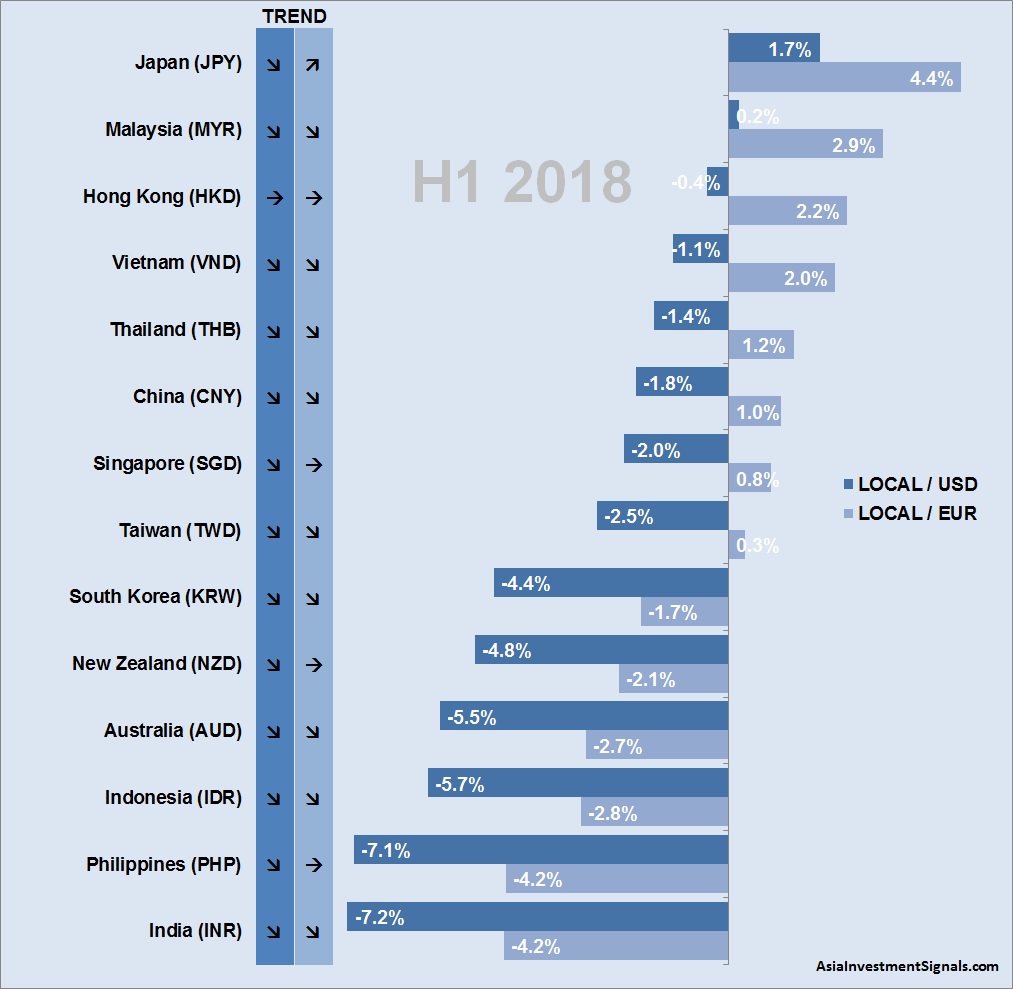
 How have the Forex Markets in Asia-Pacific performed this year? A look at the development of the different currencies in Asia-Pacific shows that the Japanese Yen has increased more than four percent against the EUR and almost two percent against the USD in the first six months of this year. On the bottom side, the Philippines Pesos and the Chinese Yuan lost both more than seven percent against the USD and more than four percent against the EUR during the same period.[mepr-active membership=”1734″ ifallowed=”show” unauth=”message” unauth_message=”Please login or purchase a membership to view full text.”] Most Asia-Pacific currencies lost against the USD this year as a result of rising interest rates in the US, the fear of increasing capital costs for some highly indebted emerging markets and the threat of trade barriers. The US Dollar Index, a measure of the value of the USD relative to a basket of six major foreign currencies, increased by 2.5 percent this year. As a comparison, the EUR Index, the unofficial equivalent index that represents the ratio of four major currencies against the Euro, lost 1.6 percent during the first six months of this year.
The graph shows furthermore the direction of the 50-day-moving-average of each currency against the USD (dark blue) and the EUR (light blue) as a short-term trend indicator for the possible development of the Forex Markets in Asia-Pacific over the next months.
[/mepr-active]
